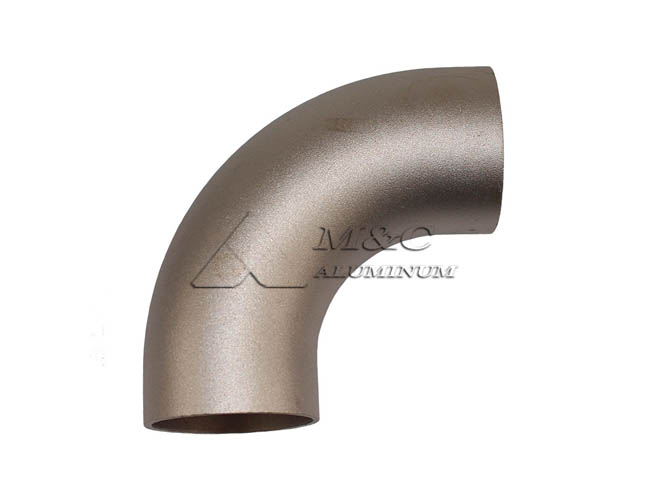
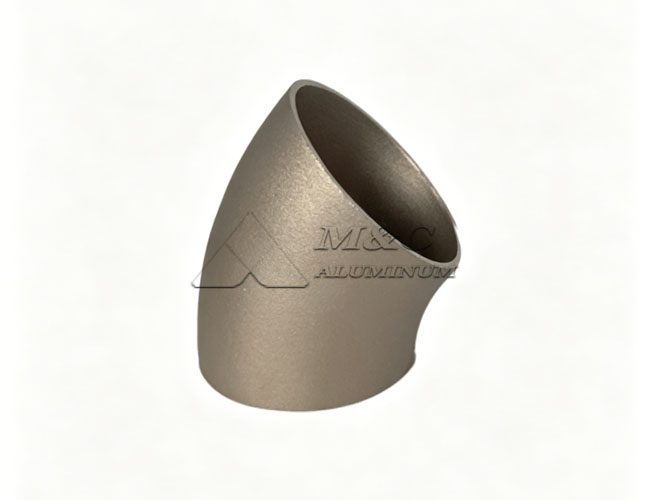
C70600 (CuNi 90/10) 45° long radius elbows are standard directional pipe fittings used in seawater piping systems on ocean-going vessels and offshore platforms. Their main purpose is to smoothly change the direction of a pipeline, reduce seawater erosion and wear, and support the long-term stable operation of piping systems.
Designed specifically for highly corrosive marine environments involving seawater and salt spray, these elbows are essential fittings for engine-room cooling systems, ballast water systems, and seawater firefighting pipelines.
Product Overview
C70600, also known as 90/10 copper-nickel alloy, contains approximately 90% copper and 9%–11% nickel, with iron and manganese added to improve performance. It is one of the most widely used copper-nickel materials for marine seawater piping systems.
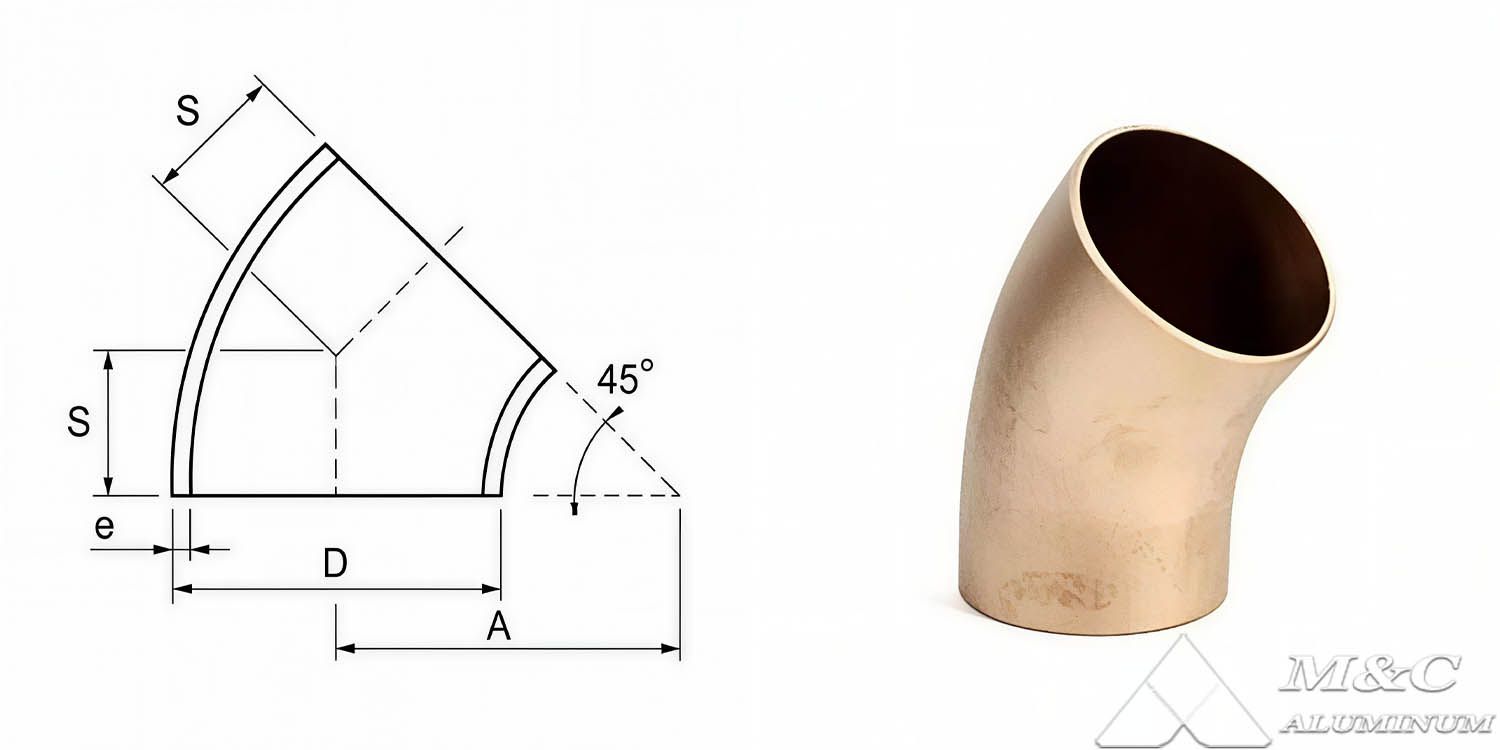
A 45° elbow changes the flow direction of a pipe by 45 degrees. It is suitable for applications where piping needs to turn diagonally, gradually change direction, or bypass equipment.
A long radius (LR) elbow has a centerline bending radius of R = 1.5D, where D is the nominal pipe diameter. This differs from a short radius elbow, which typically has a bending radius of R = 1D.
Compared with short radius elbows, 45° long radius elbows provide a smoother turning curve, lower flow disturbance, and reduced turbulence impact. Under high-velocity seawater service, they can help reduce the risk of erosion-corrosion at the outer curve of the elbow. They are therefore commonly preferred for seawater piping applications requiring stable flow performance.
Compared with 90° long radius elbows, 45° elbows have a smaller turning angle. Fluid passes through them more smoothly, and local flow resistance is generally lower.
These fittings are commonly manufactured by seamless hot-pushing or forming processes and are usually connected by butt welding. They can be supplied for inspection and certification in accordance with the requirements of classification societies such as CCS, DNV, and LR. When used together with matching C70600 straight pipes, tees, and reducers, they help avoid galvanic corrosion caused by dissimilar-metal connections.
Main Functions of Marine C70600 45° Long Radius Elbows
A CuNi 90/10 45° long radius elbow does more than simply make a pipe turn. It also helps optimize fluid flow and improve the reliability of the overall marine piping system.
1. Changing the Direction of Marine Pipelines
Space inside ship engine rooms, pump rooms, ballast tanks, and equipment compartments is often limited. Pipelines must pass through different compartments and connect with pumps, valves, heat exchangers, filters, and other equipment interfaces.
Straight pipes alone cannot meet all installation requirements. Elbows are therefore needed to adjust the pipeline direction.
A 45° long radius elbow enables the pipeline to change direction gradually, making it easier to avoid obstacles, adapt to vessel structures, and create a more reasonable piping layout.
2. Reducing Flow Resistance and Pressure Loss
When seawater or other fluids pass through a sharp pipe bend at high speed, significant flow resistance, local pressure loss, and vortices can occur. This is especially important at pump outlets, high-flow areas, and large-volume circulation systems, where sharp turns may reduce system efficiency.
Because a 45° long radius elbow provides a gentler turn, it allows fluid to change direction progressively and reduces sudden impact. In seawater pump, cooling-water circulation pump, and ballast pump systems, the proper use of long radius elbows can help maintain stable flow and pressure.
3. Reducing Seawater Erosion-Corrosion
Seawater is corrosive and may also contain sand, shell fragments, suspended particles, and marine biological residues. When fluid changes direction inside an elbow, continuous erosion may occur on localized areas of the inner wall.
The long radius design reduces direct impact against the pipe wall and helps minimize abnormal local velocities and turbulent flow. Combined with the good seawater corrosion resistance of C70600 copper-nickel alloy, this design can improve the service life of elbows in seawater piping systems.
4. Optimizing Installation and Maintenance Space
Marine piping design must meet not only fluid transport requirements but also installation, inspection, maintenance, insulation, valve operation, and equipment removal requirements.
Using 45° long radius elbows allows pipelines to follow a more natural route, avoiding excessively concentrated right-angle turns and making future inspection and maintenance easier.
This is particularly beneficial in large vessels, offshore platforms, and modular marine engineering systems, where proper elbow arrangement can reduce piping interference and improve installation efficiency.
Why Choose C70600 Copper-Nickel Alloy for Marine Elbows?
C70600 copper-nickel alloy offers good seawater corrosion resistance and mechanical properties, making it well suited to marine seawater pipelines and offshore engineering equipment.
1. Good Seawater Corrosion Resistance
Its alloy composition, primarily copper, nickel, iron, and manganese, helps improve resistance to seawater corrosion. This makes C70600 suitable for long-term use in marine seawater piping systems.
2. Good Resistance to Erosion-Corrosion
C70600 can withstand continuous seawater flow under properly controlled velocity conditions, helping reduce the risk of erosion-corrosion on the internal surface of fittings.
3. Good Mechanical Properties
The alloy provides a good balance of strength, ductility, and workability, enabling it to meet marine piping connection and forming requirements.
4. Good Weldability
With appropriate copper-nickel welding procedures and matching filler metals, C70600 elbows can be reliably welded to copper-nickel pipes.
5. Suitable for Offshore and Marine Applications
With proper design, installation, and maintenance, C70600 can perform well in humid marine atmospheres, salt-spray environments, and seawater service, helping reduce corrosion-related maintenance requirements.
Technical Specifications
| Item | Specification |
| Material | C70600 / CuNi 90/10 copper-nickel alloy |
| Elbow Angle | 45° |
| Bending Radius | Long Radius (LR), R = 1.5D |
| Nominal Size | DN15–DN300; larger sizes DN350–DN600 available as fabricated/welded elbows |
| Outside Diameter Standards | ASME B36.19, DIN 86088, GB/T 1527 marine copper pipe series |
| Wall Thickness | Schedule 10, Schedule 40, Schedule 80, or custom thickness according to customer drawings |
| Manufacturing Process | DN15–DN200: seamless hot-pushed/forming; DN250 and above: plate-formed and welded with NDT inspection |
| Connection Type | Beveled Butt Weld (BW); Socket Weld (SW) available for small sizes |
| Applicable Standards | ASTM B466, ASME B36.19, DIN 86088, EEMUA 145 |
| Surface Condition | Pickled and cleaned, free from oil and burrs, suitable for marine pipeline welding |
| Optional Certificates | CCS, DNV, LR classification certificates, PMI test report, hydrostatic test report, material certificate |
Typical Applications of 45° Long Radius Copper-Nickel Elbows
Based on their material and flow characteristics, 45° long radius copper-nickel elbows are commonly used in the following applications:
Directional changes in marine seawater cooling systems;
Ballast water system piping layouts;
Firefighting water and bilge water systems;
Seawater piping on offshore platforms and marine facilities;
Pipe prefabrication, repair, and replacement during shipbuilding and ship repair;
Other marine piping applications requiring corrosion resistance and low flow resistance.
What Is the Difference Between a 45° Long Radius Elbow and a 90° Elbow?
Both 45° and 90° elbows are commonly used in marine piping design, but they serve different purposes.
Comparison Item | 45° Long Radius Elbow | 90° Long Radius Elbow |
| Turning Angle | 45° | 90° |
| Flow Direction Change | Gradual directional change | Right-angle or perpendicular directional change |
| Flow Resistance | Relatively low | Relatively higher |
| Pressure Loss | Relatively low | More noticeable |
| Space Requirement | Requires more piping space | More compact layout |
| Typical Use | Gradual direction adjustment, equipment avoidance, reduced erosion | Where rapid direction change is required |
If sufficient installation space is available and the system has high requirements for flow capacity, pressure loss, and erosion control, a 45° long radius elbow is often the better choice.
In some cases, two 45° long radius elbows may be used in place of one 90° elbow to create a smoother directional change. Although this arrangement requires more pipe length and installation space, it can improve flow conditions.
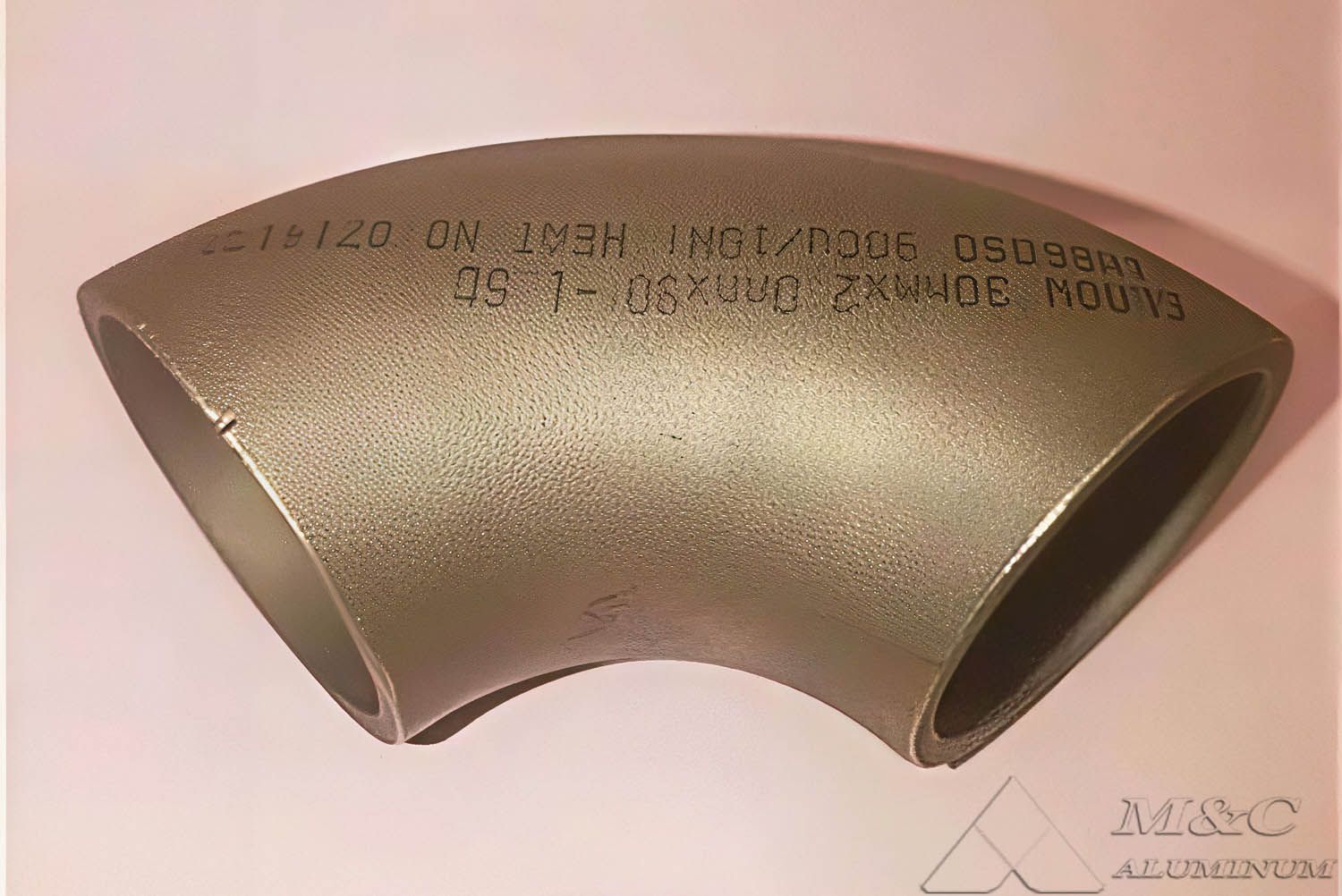
Common Connection Types for Marine C70600 45° Long Radius Elbows
Depending on pipe size, pressure rating, vessel specifications, and installation requirements, C70600 45° long radius elbows may use several connection methods.
Butt Weld Connection
Butt welding is one of the most common connection methods. It is suitable for medium and large pipe sizes, higher-pressure systems, or permanently installed pipelines.
After welding the elbow to the straight pipe, a continuous and structurally reliable piping system is formed.
Butt weld connections offer good sealing performance, high pressure-bearing capability, and strong structural stability. However, matching copper-nickel welding consumables and appropriate welding procedures are required.
Socket Weld Connection
Socket weld connections are generally used for some small-diameter pipelines. The pipe is inserted into the socket end of the elbow and then welded in place.
This method is convenient for installation, but its suitability should be confirmed according to design pressure, pipe size, and project specifications.
Flanged Connection
Flanged connections may be used at locations requiring regular dismantling or maintenance, such as pumps, valves, filters, and heat exchangers.
Flanged joints are convenient for maintenance. However, attention should be given to gasket selection, bolt material, tightening torque, and corrosion isolation measures.
FAQ
Q1: How should I choose between a C70600 45° long radius elbow and a 316L stainless steel elbow for seawater piping?
A: For clean seawater, long-term continuous flow, and applications where resistance to marine biofouling is important, C70600 copper-nickel alloy is generally preferred. For applications with limited budgets or intermittent service conditions, 316L stainless steel may be considered based on the actual chloride concentration, operating temperature, flow condition, and corrosion assessment. However, stainless steel does not offer the same anti-biofouling characteristics as copper-nickel alloy and may be more prone to deposit accumulation in certain seawater conditions.
Q2: How should 45° and 90° elbows be used together?
A: For pump inlets and outlets, areas before and after heat exchangers, and main pipelines, 45° long radius elbows are generally preferred where space allows. For compact spaces or secondary branch lines requiring a rapid change of direction, 90° elbows may be used.
Q3: Can classification certificates and export documents be provided?
A: Yes. Products can be supplied for inspection and certification by classification societies such as CCS and DNV. Full English documentation can be provided for export shipbuilding and offshore projects, including material certificates, inspection reports, PMI reports, hydrostatic test reports, and other documents as required.
Original Source: https://www.marinealum.com/a/what-is-a-marine-c70600-45-degrees-long-radius-elbow-used-for.html
Tag: 45 Degree Copper Nickel Elbow 45° Long Radius Copper Nickel Elbow 90/10 CuNi Seamless Elbow ASME B16.9 Copper Nickel Fittings CuNi 90/10 Marine Elbow Marine Copper Nickel Pipe Fittings ASME B16.9 CuNi 90/10 Butt Weld Elbow UNS C70600 Seawater Piping